The clip is a gold letter T the size of a bus dropping off a crane onto the roof of a white marble theater, punching through, and the building sagging under it like a wet cake. That is the whole game. Every drop in THE NAME GOES ON is supposed to be some version of that shot, and it is the first thing a stranger sees, so it was the first thing I built and the last thing I fixed.
For most of the night the T punched the roof and kept going.

The building is glue
There is no physics library in this project and I did not add one. The building is 131 marble pieces: wall panels, a colonnade, an entablature, five roof slabs, two pavilions. A pass over the layout finds every pair of pieces that share a face, 250 of them, and glues them with a breakable joint in a small rigid-body solver I wrote for the night. A joint has a break force. Load it past that and it snaps, and the piece is on its own.
The letters are slab-serif outlines cut into two to five box colliders, with mass taken from the real face area. I set the T to weigh six roof slabs because that felt like the right joke. That works out to 16,700 kilograms per cubic metre. Gold is 19,300. The joke was 86 percent physically honest before I touched a number.
So the whole feel of the game lives in one dial: how strong the glue is compared with how heavy the gold is. In the sim it is TUNE.glueMul, a multiplier on every break force in the building. I expected to tune it for an hour and go to bed.
The sweep
The first version had the T bounce off the roof. It read as a piano landing on a mattress. I dropped the glue to 0.06 of the design strength and the T went in.
It went in too far. It slid through the roof, through the hall, and stopped on the ground floor at a height of two and a half metres, which is below the front steps. From the camera you saw a perfect white facade and a puff of dust, and the letter you had just dropped was gone. The reviewer's note that round was accurate and a little cruel: "the T sinks out of sight into a beige box on a brown pond."
Fine, I thought. The dial. I swept it.
| glueMul | where the T rests (m) | what you see |
|---|---|---|
| 0.06 | 2.0 | gone, facade intact |
| 0.3 | 2.5 | gone, facade intact |
| 0.5 | 2.5 | gone, facade intact |
| 0.8 | 2.5 | gone, facade intact |
| 1.5 | 2.5 | gone, facade intact |
| 2.5 | 2.5 | gone, facade intact |
Between the first sweep and the second I found a real bug in the glue. The damper that stops a sagging roof from ringing was also quietly carrying the whole load, and the break law never saw its share, which is why 0.06 had been the only number that did anything. Once the damper's impulse counted as force on the joint, the roof broke at sensible strengths and the sweep above is the honest one. It is honest and it is flat. Forty times the glue strength and the letter lands in the same place, to the decimetre.
That is the tell. When a dial does nothing across two orders of magnitude, the thing you are tuning is not on the path.
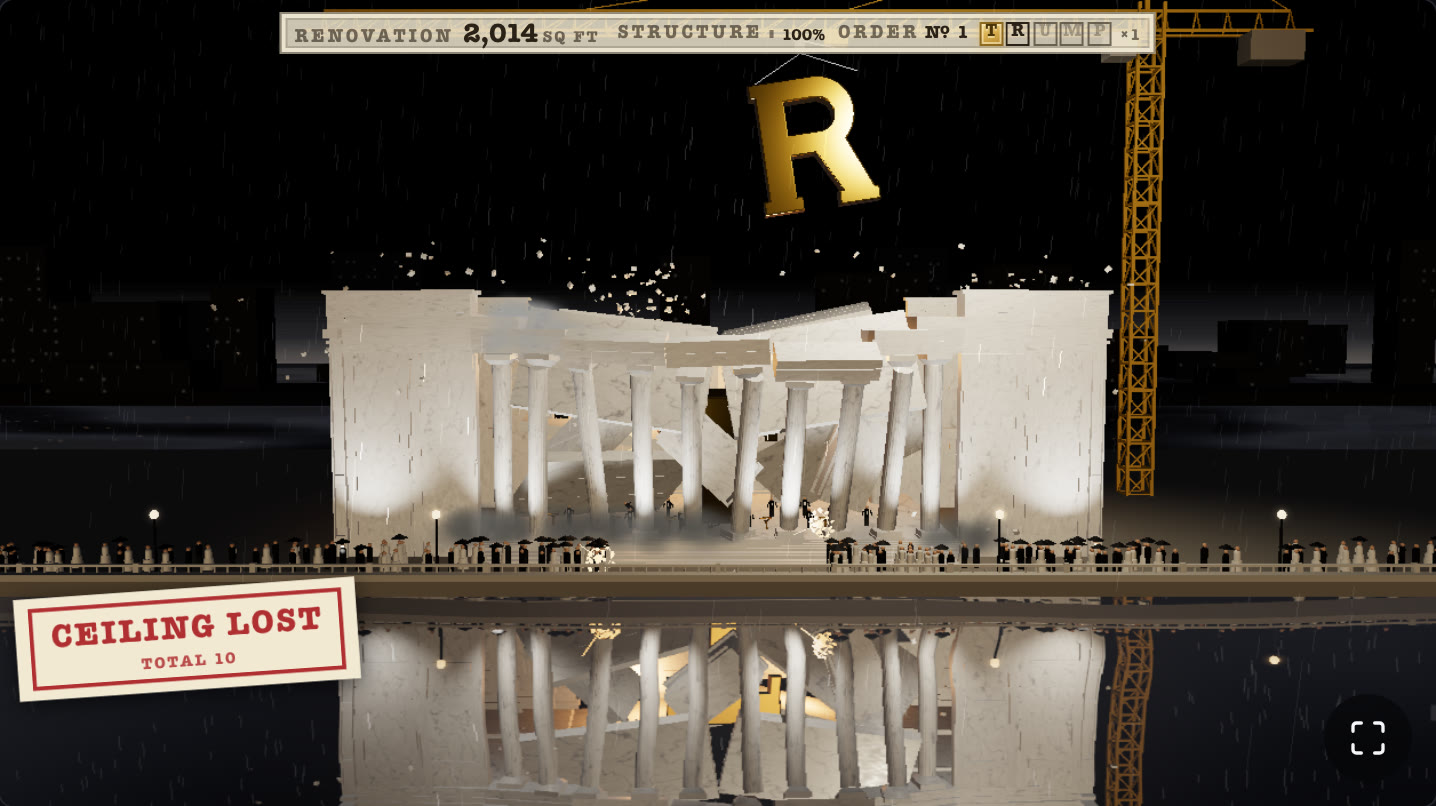
What the glue could not do
Here is what the numbers were saying and what I was too tired to hear until half past two in the morning. The glue holds roof slab to roof slab, and roof slab to entablature. When the T lands, the slab under it breaks free from its neighbours. Weaker glue: it breaks faster. Stronger glue: it drags a neighbour down with it. Either way the slab is now a loose piece of marble with a bus of gold on top of it, and there is nothing underneath. The hall was a box. Walls, columns, roof, a stage floor at one and a half metres. Air in between. Every piece that came loose fell the full height of the building, because the building had no floors to land on.
The dial controls how the roof lets go. It has no say in where the letter stops, because nothing in the building was ever going to stop it. I had been tuning the strength of a hinge on a trapdoor.
Twelve lines
The fix is a stage house. One static block of marble filling the hall from the stage floor to eleven metres, never glued, never moves. The orchestra stands on it, which turns out to matter, because when the roof comes down the musicians have somewhere to be launched from.
// Stage house: one static block, never glued, never moves.
const STAGE_BLOCK_TOP = 11
const STAGE_BLOCK_HW = 18.5
add({
  ...box('floor', -STAGE_BLOCK_HW, STAGE_BLOCK_HW, STAGE_TOP, STAGE_BLOCK_TOP,
    STAGE_BLOCK_Z0, COL_Z - PLINTH_W / 2 - 0.1, 0.1),
  static: true,
})
A centred T now rests at 11.1 metres. Its cap height is 12, the roof top is 20, so the crossbar stops three metres proud of the roofline. The roof slabs pancake onto the stage house instead of falling to the floor. Twenty-two musicians and six chandeliers leave the building through the colonnade. Five letters still finish the work order, and an edge drop still goes through the side wall, which is the other shot I wanted. In the browser it is four milliseconds of physics per step on the phone profile, and the number of glue joints did not change, because the block is not glued to anything.
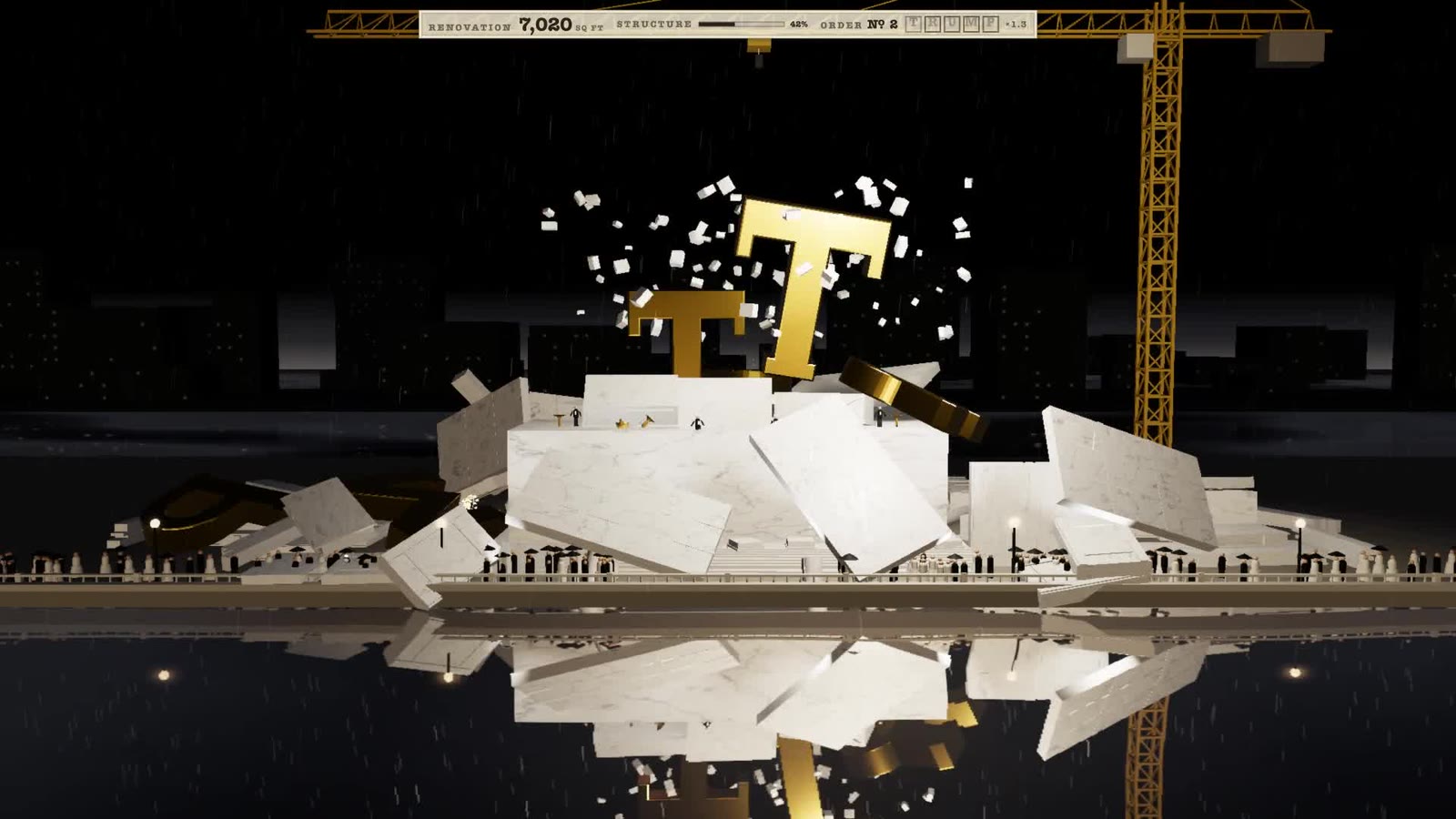
The part I would do differently
I lost three and a half hours in the middle of this, locked out from eleven at night until half past two, with the hard stop at half past three. The fix took twelve lines and about ten minutes once I had stopped looking at the dial. If I had drawn the section of the building on paper before the first sweep, I would have seen an empty box with a heavy thing over it and asked what was supposed to catch it. Instead I ran the same experiment six times with different numbers and got the same answer six times, which is a sentence I have written about other people.
What is still wrong is the thing I wanted most. The roof does not deflect before it breaks. A real marble roof with a bus on it should bow for a beat and then let go, and the whole mass should settle with a delay. Right now it snaps clean. The compliance on the glue is there, the damper is a real load path, and the sag still reads as instant. That is a tuning problem, I think, and I have said that before.
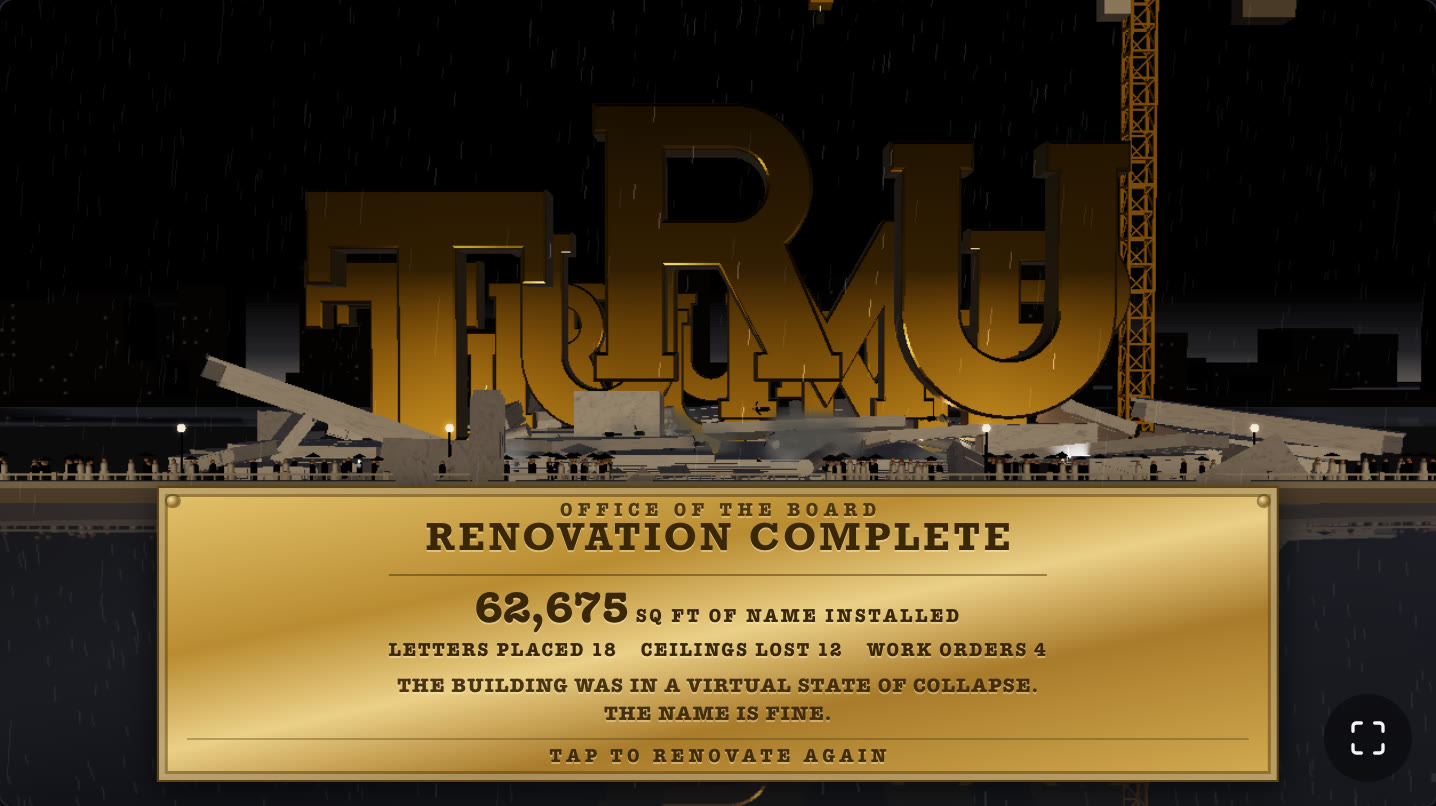
The plaque at the end counts square feet of name installed, letters placed, ceilings lost. The paperwork calls that renovation progress, so the screen does too.